

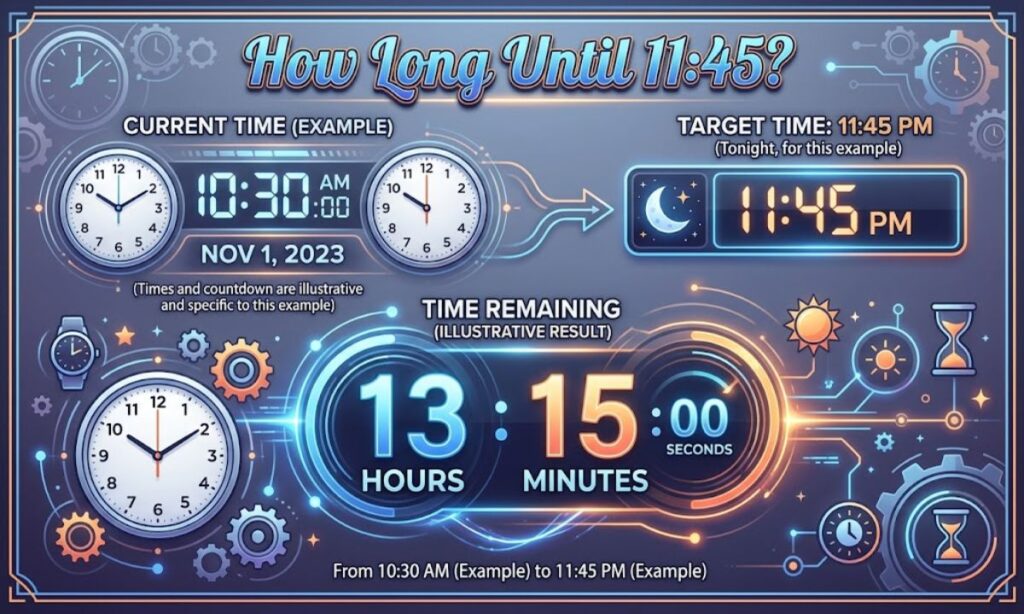
The time left until 11:45 equals 11:45 minus the current time on a 24-hour clock. If it is 11:00 AM now, 45 minutes remain. If it is 8:00 AM, 3 hours and 45 minutes remain.
This page was written for people who need the answer now and want to understand it too. You will find a quick method, two lookup tables, worked examples, and fixes for the mistakes that cause most errors.
Quick Answer: How Long Until 11:45 Right Now?
No static page can show your exact countdown, because the answer depends on the minute you are reading this. Here is the fastest way to get it.
- Look at the current time on your phone or computer.
- Decide whether you mean 11:45 AM (morning) or 11:45 PM (night).
- Subtract the current time from 11:45, using the 24-hour method below.
Fastest shortcut: ask a voice assistant to “set a timer until 11:45.” Most phones and smart speakers handle it. A live countdown website will also do it for you.
11:45 AM vs 11:45 PM: Which One Do You Mean?
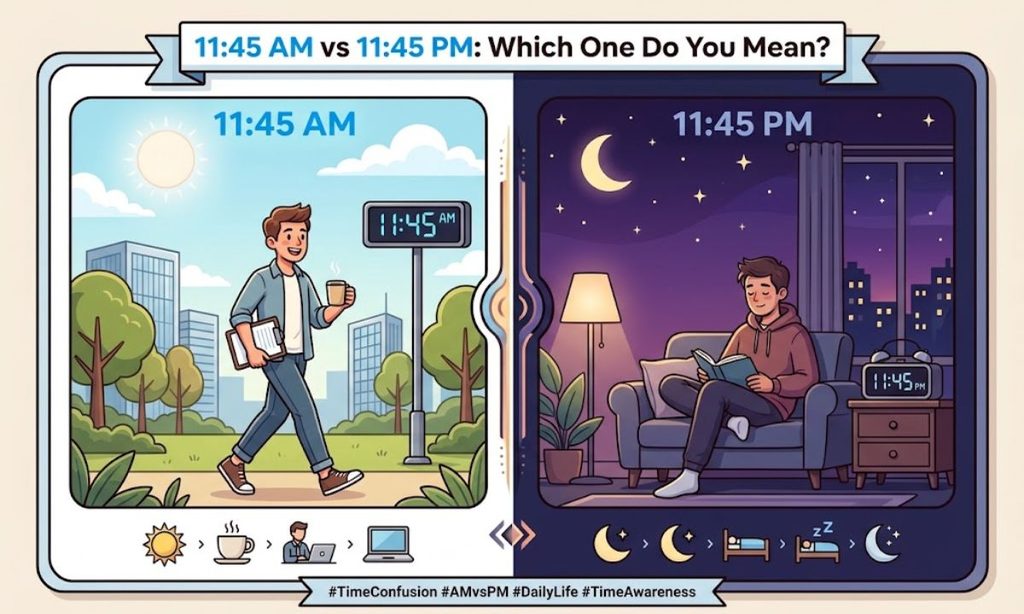
These are two different moments, almost 12 hours apart.
| Feature | 11:45 AM | 11:45 PM |
| 24-hour format | 11:45 | 23:45 |
| Military time | 1145 | 2345 |
| Minutes after midnight | 705 | 1,425 |
| Seconds after midnight | 42,300 | 85,500 |
| Time of day | Late morning | Late night |
| Time before the next hour | 15 minutes before noon | 15 minutes before midnight |
11:45 AM is 15 minutes before 12:00 PM (noon), and 11:45 PM is 15 minutes before midnight. That quarter-hour gap is the easiest way to remember both.
How to Calculate How Long Until 11:45
You do not need a calculator. Two methods cover every case, and both take under a minute.
Method 1: Count Up to the Hour, Then Add 45
This is the best mental-math method for 11:45 AM.
- Count the full hours from now to 11:00.
- Add 45 minutes.
- If the current time has minutes, subtract them.
Example: it is 8:20 AM.
- From 8:20 to 11:00 is 2 hours and 40 minutes.
- Add 45 minutes: 3 hours and 25 minutes.
Result: 3 hours and 25 minutes until 11:45 AM.
Method 2: Convert to Minutes After Midnight
This method is the most reliable when the numbers get messy. It also works for any target time.
- Convert both times to minutes after midnight.
- Subtract the current time from the target.
- Convert the answer back to hours and minutes.
Formula: (Target hours × 60 + Target minutes) − (Current hours × 60 + Current minutes)
Example: it is 8:20 AM and the target is 11:45 AM.
- Target: 11 × 60 + 45 = 705 minutes.
- Now: 8 × 60 + 20 = 500 minutes.
- Difference: 705 − 500 = 205 minutes.
- 205 minutes is 3 hours and 25 minutes.
Both methods give the same answer, which is a handy self-check.
Minutes after midnight is the cleanest way to compare any two clock times. Once both times are plain numbers, the subtraction is ordinary arithmetic.
How Long Until 11:45 AM: Quick Reference Chart
Find the current time in the left column to see the wait until 11:45 AM today.
| Current time | Time until 11:45 AM |
| 12:00 AM (midnight) | 11 hours 45 minutes |
| 3:00 AM | 8 hours 45 minutes |
| 6:00 AM | 5 hours 45 minutes |
| 7:00 AM | 4 hours 45 minutes |
| 8:00 AM | 3 hours 45 minutes |
| 9:00 AM | 2 hours 45 minutes |
| 10:00 AM | 1 hour 45 minutes |
| 10:30 AM | 1 hour 15 minutes |
| 11:00 AM | 45 minutes |
| 11:15 AM | 30 minutes |
| 11:30 AM | 15 minutes |
| 11:40 AM | 5 minutes |
| 11:44 AM | 1 minute |
On any whole hour before 11:00 AM, the wait is always a whole number of hours plus 45 minutes. That pattern lets you skip the arithmetic entirely.
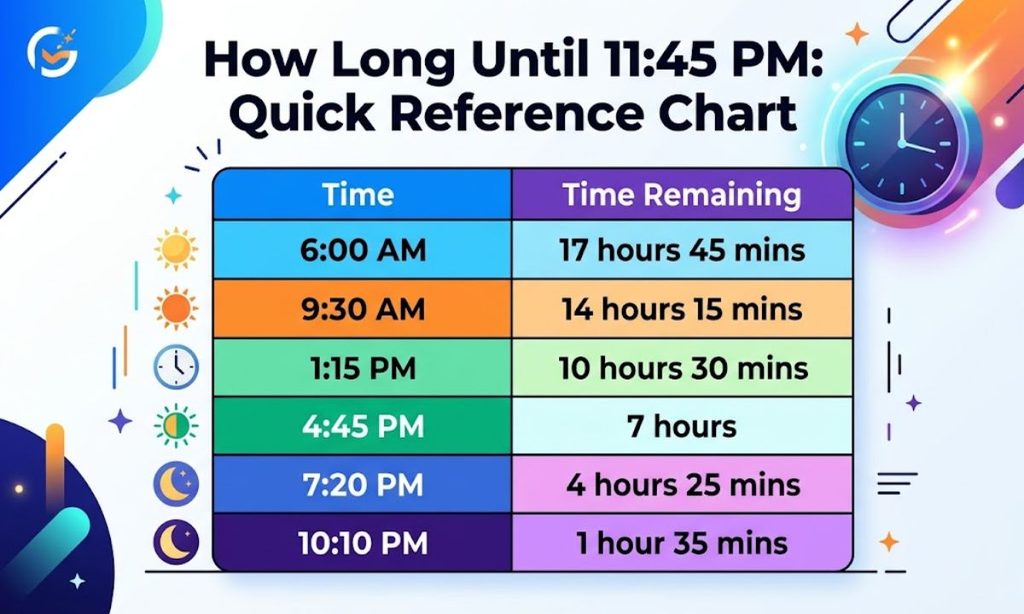
How Long Until 11:45 PM: Quick Reference Chart
This chart covers the evening version of the same question.
| Current time | Time until 11:45 PM |
| 12:00 PM (noon) | 11 hours 45 minutes |
| 3:00 PM | 8 hours 45 minutes |
| 5:00 PM | 6 hours 45 minutes |
| 6:00 PM | 5 hours 45 minutes |
| 8:00 PM | 3 hours 45 minutes |
| 9:00 PM | 2 hours 45 minutes |
| 10:00 PM | 1 hour 45 minutes |
| 11:00 PM | 45 minutes |
| 11:30 PM | 15 minutes |
| 11:40 PM | 5 minutes |
Between noon and 11:00 PM, the wait until 11:45 PM is the 24-hour clock difference from 23:45. At 3:00 PM (15:00), subtract 15:00 from 23:45 to get 8 hours and 45 minutes.
What If 11:45 Has Already Passed Today?
This is the most common source of wrong answers. Many people subtract and get a negative number.
If 11:45 AM has already passed, the next 11:45 AM is tomorrow. Add 24 hours to the target, then subtract the current time.
Worked example: it is 2:10 PM and you want the next 11:45 AM.
- Time from 2:10 PM to midnight: 9 hours 50 minutes.
- Time from midnight to 11:45 AM: 11 hours 45 minutes.
- Add them: 21 hours 35 minutes.
Second example: it is 10:20 PM and you want 11:45 AM tomorrow.
- 10:20 PM to midnight: 1 hour 40 minutes.
- Midnight to 11:45 AM: 11 hours 45 minutes.
- Total: 13 hours 25 minutes.
A negative result always means the target time falls tomorrow. Add 24 hours (1,440 minutes) to the answer and you have the correct wait.
Understanding 12-Hour and 24-Hour Time
A large share of time-calculation mistakes come from AM and PM confusion. Knowing the 24-hour system removes the problem.
- 12-hour clock: counts 1 to 12 twice a day, with AM and PM labels.
- 24-hour clock: counts 0 to 23 once a day, with no labels.
- Midnight is 12:00 AM or 00:00.
- Noon is 12:00 PM or 12:00.
To convert a PM time to 24-hour time, add 12 to the hour. So 11:45 PM becomes 23:45. AM times stay the same, except 12 AM becomes 00.
The 24-hour clock is the standard in military, aviation, healthcare and most of Europe, because it prevents AM/PM misreads. That is why “military time” for 11:45 PM is written 2345.
Here is how to say it aloud:
- 11:45 AM: “eleven forty-five A.M.” or “a quarter to twelve.”
- 11:45 PM: “eleven forty-five P.M.” or “a quarter to midnight.”
- 1145 and 2345: “eleven forty-five hundred” and “twenty-three forty-five.”
11:45 Across Time Zones
“Until 11:45” always refers to local time, so the answer shifts if you are coordinating across regions. The table below uses fixed UTC offsets that do not change with daylight saving.
| If it is 11:45 AM in UTC | Local time at that offset |
| UTC−5 | 6:45 AM |
| UTC+0 | 11:45 AM |
| UTC+1 | 12:45 PM |
| UTC+4 | 3:45 PM |
| UTC+5 | 4:45 PM |
| UTC+5:30 | 5:15 PM |
| UTC+8 | 7:45 PM |
| UTC+9 | 8:45 PM |
Time zones are measured as offsets from Coordinated Universal Time (UTC). To convert, add the other zone’s offset and subtract your own.
A few tips for cross-zone planning:
- Name the zone in every invitation, such as “11:45 AM UTC.”
- Check daylight saving. Many regions shift their clocks on different dates, so offsets can change.
- Use a world clock in your phone’s clock app for recurring calls.
- Watch the date line. A late-evening time in one zone can already be tomorrow in another.
Why Do People Search “How Long Until 11:45”?
The query is short, but the reasons behind it vary. Understanding them helps you pick the right tool.
Meetings, Classes and Appointments
Many schedules cluster around quarter-to times. Classes, school periods and sessions often end at 11:45, and people use countdowns to pace themselves.
Lunch and Breaks
For office and school routines, 11:45 AM is a common point to start heading to lunch. A quick countdown shows how much working time remains.
Deadlines and Submissions
Late-night cutoffs matter most here. An 11:45 PM deadline leaves a 15-minute buffer before midnight, and many people use that buffer for last-minute uploads.
A good rule for deadlines is to finish at least 10 minutes early. Upload delays, slow connections and clock differences between systems can all cause a late submission.
Travel and Transport
Flights, trains and buses are often listed in local time. Knowing the wait to 11:45 helps you plan transfers and check-in windows.
Shift Work and Night Schedules
For night-shift staff and students, 11:45 PM is a natural checkpoint before midnight. It often marks the last stretch of a shift or study session.
Habits, Reminders and Alarms
Some people use a fixed time to anchor a routine, such as a short walk or a reminder to log off. A countdown makes that anchor feel concrete.
Best Ways to Track the Countdown
You have several options, each suited to a different situation.
| Method | Best for | Effort |
| Voice assistant timer | Hands-free, fast answers | Very low |
| Phone alarm | Reliable reminders | Low |
| Live countdown website | Visual second-by-second display | Low |
| Calendar event with alert | Meetings and recurring tasks | Medium |
| Mental math (methods above) | No device available | Medium |
A phone alarm is more dependable than a browser tab for important times. Browsers can pause background tabs, which can delay a countdown alert.
Tips for Setting a Reliable Reminder
- Set the alarm for 11:40 instead of 11:45 to leave a margin.
- Choose a distinct alarm sound so you notice it.
- Confirm AM or PM on the alarm screen before saving.
- Check that Do Not Disturb will not silence the alert.
Common Mistakes When Calculating Time Remaining
These errors show up repeatedly. Check them first when an answer looks off.
- Mixing AM and PM. Calculating to 11:45 PM when you meant AM changes the result by 12 hours.
- Treating 60 as 100. Time uses base-60 minutes, so 9:50 to 10:20 is 30 minutes, not 70.
- Forgetting the midnight rollover. A negative answer means the target is on the next day.
- Ignoring time zones. A deadline stated in another zone changes your own countdown.
- Overlooking daylight saving changes. On clock-change days, one day can have 23 or 25 hours.
- Forgetting seconds. For tight deadlines, a countdown that shows seconds is safer than rounding to minutes.
Time arithmetic is base-60, not base-10. Always borrow 60 minutes, not 100, when subtracting across an hour.
Handy Mental-Math Tricks
These shortcuts speed up the calculation for 11:45 specifically.
- The “quarter-to” trick: 11:45 is a quarter-hour before 12:00. Find the wait until noon, then subtract 15 minutes.
- The “add 45” trick: from any whole hour before 11, add 45 minutes to the hours remaining until 11:00.
- The “round up” trick: round the current time up to the next quarter hour, then adjust.
- The 705 anchor: memorize that 11:45 AM is minute 705 of the day, and subtract the current minute count from it.
Quarter-hour thinking works best for 11:45, because the target sits exactly on a quarter mark. Wherever the current time lands, you can count in 15-minute steps.
Example with the quarter-to trick: it is 9:30 AM.
- Wait until noon: 2 hours 30 minutes.
- Subtract 15 minutes: 2 hours 15 minutes until 11:45 AM.
Read More: How Long Until 2:20 PM? The Fastest Way to Calculate It
Quick Facts About 11:45
A few facts are worth keeping in your head:
- 11:45 AM is the 705th minute of the day.
- 11:45 PM is the 1,425th minute of the day.
- 11:45 PM is 15 minutes before midnight, the start of a new calendar day.
- From 11:45 AM to 11:45 PM is exactly 12 hours.
- There are 96 quarter-hour blocks in a full day, and 11:45 closes one of them.
One day contains 1,440 minutes and 86,400 seconds. That figure is the basis for every conversion in this guide.
Frequently Asked Questions
How long until 11:45 AM?
The wait equals 11:45 minus the current time. For example, at 9:00 AM it is 2 hours and 45 minutes.
How long until 11:45 PM?
Subtract the current time from 23:45. At 8:00 PM, 3 hours and 45 minutes remain.
What is 11:45 PM in 24-hour time?
11:45 PM is 23:45 in 24-hour time. It is written 2345 in military time.
What is 11:45 AM in military time?
11:45 AM is 1145 in military time. It is 705 minutes after midnight.
How many minutes are there from midnight to 11:45 AM?
There are 705 minutes. That is 11 hours times 60 plus 45 minutes.
How many seconds until 11:45 AM from midnight?
There are 42,300 seconds from midnight to 11:45 AM. Multiply 705 minutes by 60.
How many hours are between 11:45 AM and 11:45 PM?
Exactly 12 hours separate them. The same pair of times repeats every day.
Conclusion
Working out how long until 11:45 is simple once you pick the right method. Subtract the current time from 11:45 on a 24-hour clock, and add 24 hours if the target has already passed today.
Remember the key anchors. 11:45 AM is 705 minutes after midnight. 11:45 PM is 1,425 minutes after midnight. Each sits exactly 15 minutes before a major marker, noon or midnight.
